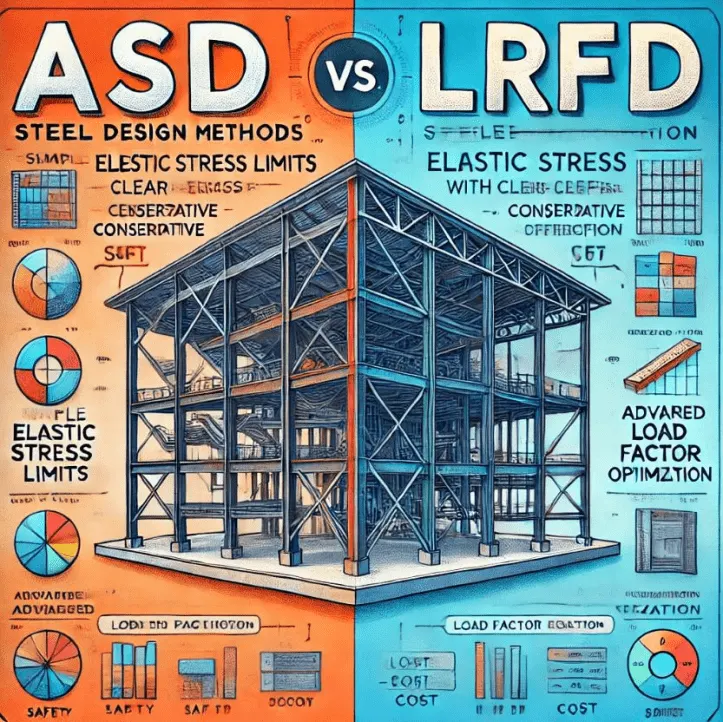
Design Method and How it Affects the Cost, Weight and Lifetime of the Project
In steel construction, choosing the right design method is critical. It significantly affects the project’s cost, weight, and overall lifetime. The two primary methods, Allowable Stress Design (ASD) and Load and Resistance Factor Design (LRFD), both offer distinct advantages and are best suited for different contexts.
Questions You Might Be Asking:
❓ Concerned about the cost and the quality of your steel construction?
❓ Struggling to understand structural designs and their complexities?
❓ Planning a steel structure but finding design standards overwhelming?
Let’s break it down together!
| Aspect | ASD (Allowable Stress Design) | LRFD (Load and Resistance Factor Design) |
|---|---|---|
| Theoretical Basis | Relies on the elastic limit of materials to ensure stress does not exceed allowable levels. | Evaluates strength limits, combining various loads with specific factors. |
| Evaluate strength limits, combining various loads with specific factors. | Formula: Resistance ≥ Factored load. | |
| Applies a single safety factor uniformly across the structure. | Uses load and resistance factors for greater flexibility. | |
| Safety | Ensures safety with a single factor, making it straightforward but sometimes overly conservative. | Accounts for real-world factors, enhancing safety in diverse conditions. |
| Cost Efficiency | May lead to higher material costs due to conservative designs. | Reduces costs by optimizing material usage without compromising safety. |
| Applicability | This may lead to higher material costs due to conservative designs. | Ideal for large-scale projects with complex and variable loads requiring precise calculations. |
| Material Usage | Designs are more conservative, leading to increased weight and cost. | Maximizes material efficiency, resulting in reduced weight and cost. |
| Durability | Structures are often more robust and durable due to conservative safety margins. | May require higher maintenance over time due to optimized usage. |
Which Method Should You Choose?
Both ASD and LRFD have strengths and weaknesses, depending on the specific project context.
ASD is favored for simpler structures, ensuring safety by using steel within a conservative force capacity. This makes it robust and durable, though often costlier due to the higher material usage.
LRFD, on the other hand, optimizes the maximum load-bearing capacity of steel members. This approach reduces material weight and costs, making it suitable for complex and economically sensitive projects. However, LRFD may require more frequent maintenance due to its efficiency-focused design.
Striking the Right Balance:
ASD emphasizes safety by operating within safe stress limits, making it more robust but costlier. LRFD, on the other hand, optimizes resources, reducing material usage and costs, but might require frequent maintenance. Both methods have their place in the steel construction industry, depending on the project’s complexity and goals.
Conclusion
Both ASD and LRFD have their strengths and weaknesses, depending on the specific project context. ASD is favored for simpler structures, ensuring safety and durability. LRFD optimizes load-bearing capacity for material efficiency and cost savings, ideal for complex projects. The choice between them ultimately depends on the specific needs and priorities of the project.
Which method do you think works best for your next project?
DisclaimerEducational use only. Not engineering, legal or code-compliance advice.
The content on StructuralWorld, including articles, diagrams, calculators and other tools, is provided for general educational and informational purposes only. It is not engineering, architectural, legal or code-compliance advice, and it does not create a professional relationship between you and StructuralWorld or its authors.
Codes, standards and regulations (for example OSHA, IBC, ADA and AISC) are revised regularly and are adopted and amended differently by each jurisdiction. Figures shown here may be simplified, may refer to a specific edition, and may be out of date or contain errors. Calculators and interactive diagrams are illustrative only and are not a substitute for design calculations, shop drawings or engineering review.
Before relying on any information for design, fabrication, erection, inspection or safety decisions, verify it against the current governing code and the project documents, and consult a qualified, licensed professional (such as a structural engineer) and the authority having jurisdiction.
To the fullest extent permitted by law, StructuralWorld and its authors make no warranties, express or implied, about the accuracy, completeness or fitness for a particular purpose of this content, and accept no liability for any loss, damage or injury arising from its use or from reliance on it. Links to third-party standards and websites are provided for convenience; that material belongs to its owners. If you find an error, please let us know.